
The Model Context Protocol (MCP) is an open standard introduced by Anthropic that provides a secure, universal language for AI models to communicate with external data sources and business applications.1 Historically, artificial intelligence systems have been limited by their isolation from live enterprise data, requiring developers to build custom connections for every single tool an AI needed to access.2 MCP solves this problem by standardizing the connection so AI can easily plug into diverse enterprise systems in a simple, reliable manner, acting as a single protocol that replaces fragmented integrations.1
To actually execute complex tasks, artificial intelligence must be able to securely connect to and operate your company's software tools. This connection is the foundational requirement that transforms a basic AI into a capable AI Agent.
What is an AI Agent?
Unlike standard chatbots that just wait for your prompt and give a static text answer, AI agents are proactive, autonomous software systems that can reason through problems, formulate plans, and take actions to achieve specific goals. For example, a marketing agent might be tasked with checking daily campaign metrics across multiple platforms, reallocating budgets to the best-performing ads, and emailing a summary to the team.
Before MCP, connecting these agents to your business infrastructure was a nightmare of fragmented custom integrations that broke easily and were difficult to scale.3
How is MCP Different from Traditional API Wrappers?
When connecting software, developers typically use APIs (Application Programming Interfaces). However, traditional APIs require developers to build a custom integration—or "API wrapper"—for every single tool and AI model pairing, creating severe fragmentation and duplicated effort.3 If you wanted your AI to use Salesforce, Google Drive, and an internal database, your engineering team had to manually write and maintain three separate, highly specific translation layers.
MCP replaces this point-to-point chaos with a universal protocol. Developers only need to implement MCP once in their agent, instantly unlocking an entire ecosystem of thousands of integrations without needing bespoke API wrappers for each one.3
What Exactly Do Agents "Understand" from MCP?
Instead of guessing how a business tool works, an AI agent uses MCP to automatically discover its capabilities. When the agent connects, it sends a standardized request to list the available tools.4 The MCP server replies by feeding the agent a highly structured "tool definition" directly into its system.3 From this, the agent instantly and precisely understands:
- The Tool's Name: The exact identifier used to call the function (for example,
get_weatherorsalesforce_updateRecord).5 - The Description: A clear, human-readable explanation of what the tool does and the specific situations where the AI should use it.5
- The Input Schema (Parameters): A strict blueprint, typically formatted as a JSON Schema, that tells the agent exactly what data formatting, required fields, and optional parameters are needed to successfully execute the tool without causing errors.6
How MCP Works for AI Agents in Practice
When we think of MCP as a tool for an AI agent, it functions basically like a universal digital translator and a traffic controller combined. Here is the workflow:
- Tool Discovery: When you give an AI agent a task, it uses its MCP client to find available servers and retrieve the exact names, descriptions, and schemas of the tools it is authorized to use.2
- Structured Requests: Armed with these precise instructions, the AI agent generates a standardized request to invoke the required tool.
- Secure Action: The MCP Server safely translates this request, fetches the live data from your business tool, and hands the information back to the AI agent in a language it perfectly understands.2
Adopted rapidly by major industry players like OpenAI, which natively supports MCP connections, and Google, MCP eliminates the need for messy custom coding, drastically reducing the cost and complexity of bringing powerful, context-aware AI automation to enterprise operations.7
Using MCP with AI Agents
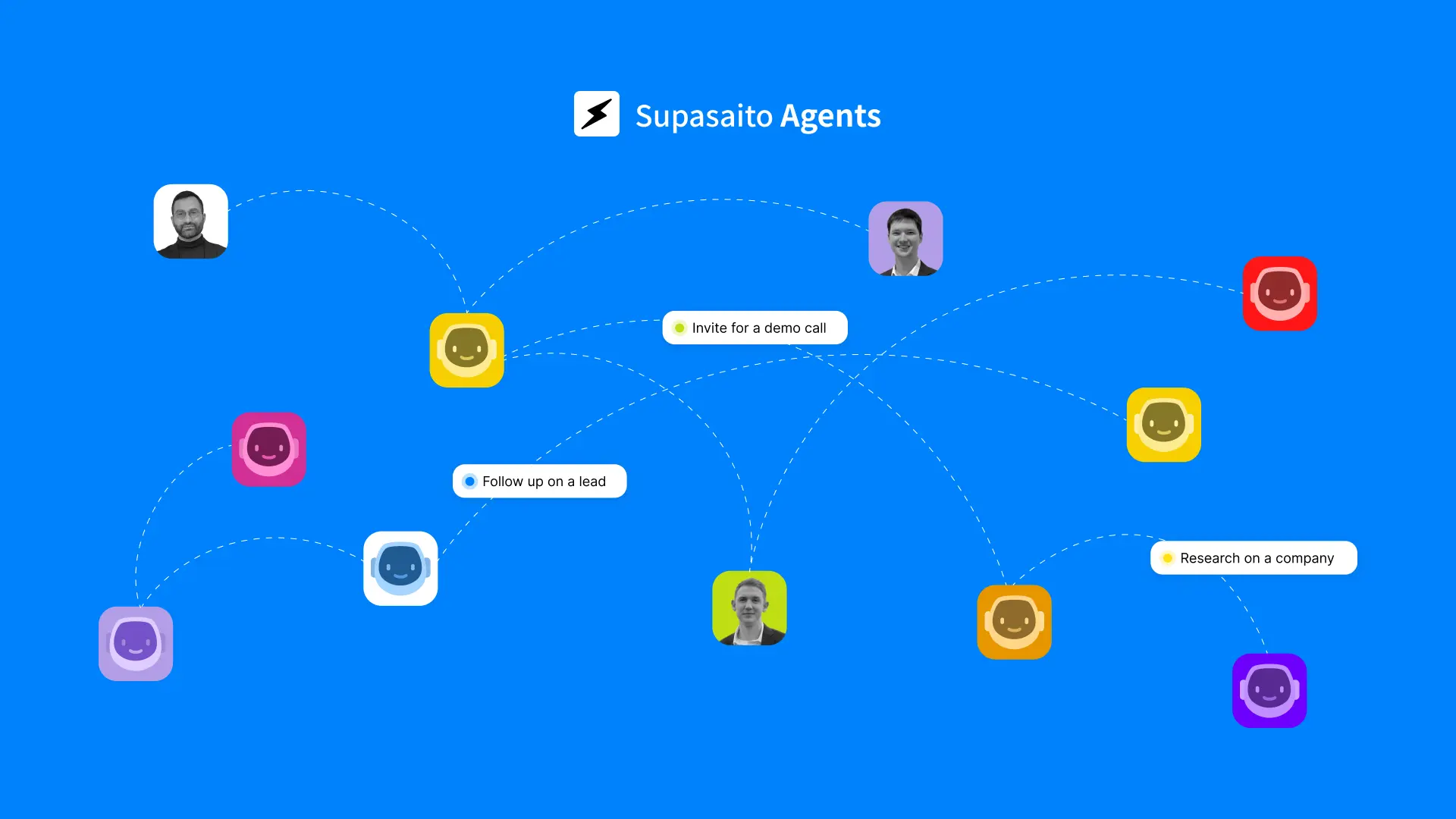
You can use MCP on Supasaito Agents by connecting any server with URL and going through authentification with OAuth or API token if that is required by the server.










.svg)
