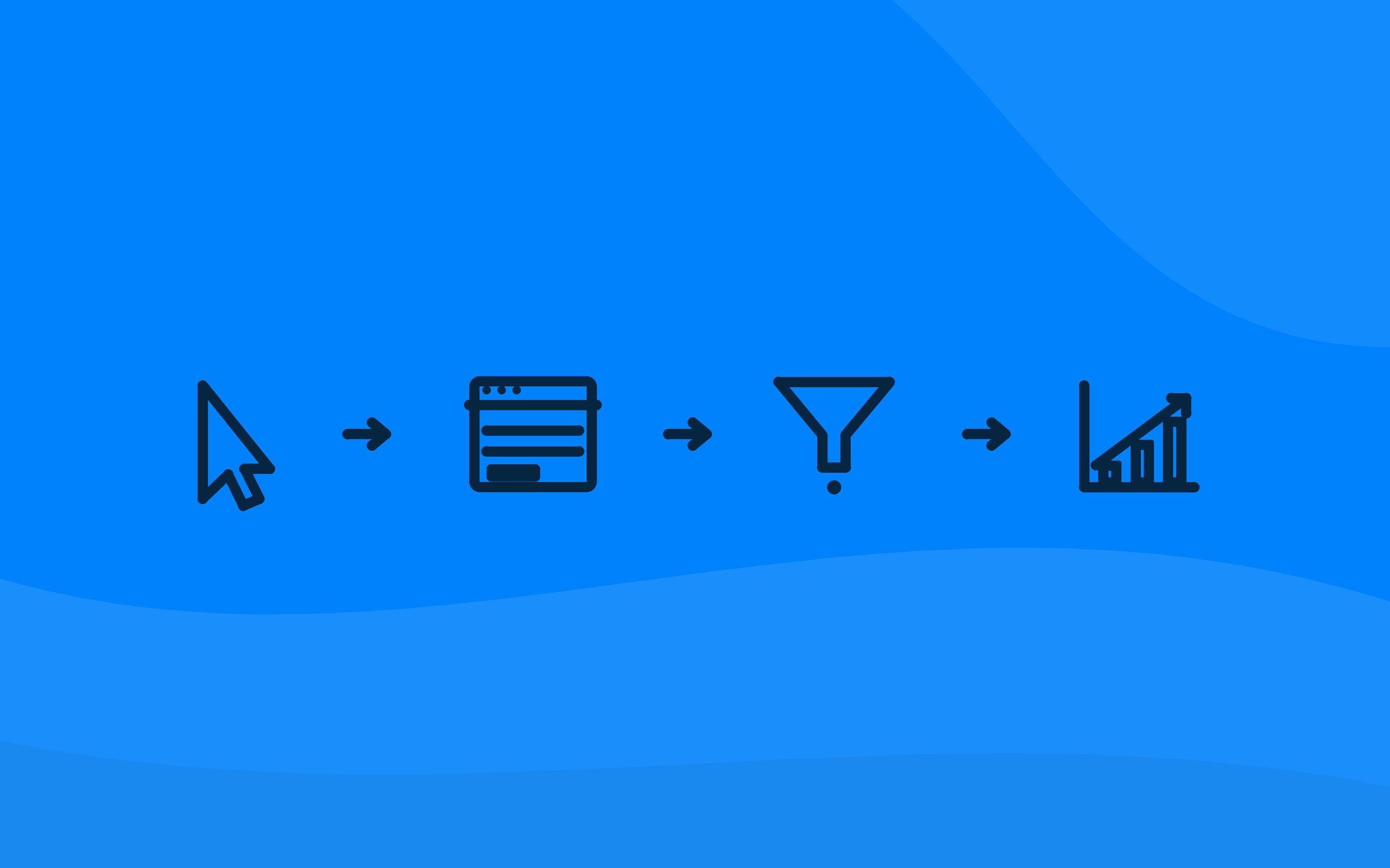
For B2B companies, your website isn't a digital brochure — it's a revenue asset that should generate leads and feed your pipeline. Yet many teams hit the same wall: they redesign the site but inquiries don't go up, or traffic climbs while conversions stay flat. More often than not, the cause is the same. Effort goes into how the site looks, while conversion rate optimization (CRO) — the discipline of turning visitors into qualified leads — gets left out entirely.
This guide explains what B2B CRO actually is, why it sits at the heart of lead generation, and how to tell a genuinely data-driven optimization partner apart from an agency that simply makes things look nice. By the end you'll have a practical vendor checklist you can use before you sign anything.
What Is B2B CRO (Conversion Rate Optimization)?
How CRO differs from ordinary web design
Conversion rate optimization (CRO) is the practice of steadily increasing the share of site visitors who complete a meaningful business goal — a contact request, a content download, a demo booking — using data rather than opinion. The key distinction is that CRO is a continuous process, not a one-off build. Where a typical web project treats launch as the finish line, CRO treats launch as the starting line.
A typical web design project is measured by visual polish and on-time delivery, decided by stakeholder opinion, and ends at launch. B2B CRO is measured by conversion rate, lead quality and CPA, decided by analytics and A/B test data, and continues well past launch with ongoing testing. In short, CRO moves website improvement from art toward science — and in B2B, where buying cycles are long and several stakeholders weigh in, deciding with evidence rather than instinct is what separates sites that perform from sites that merely exist.
Where B2B sites quietly leak conversions
Abandonment on overloaded forms. The number of fields in a form has a direct, measurable effect. Average abandonment reaches 67.8% once a form asks for more than seven fields (Formstack / Formstory), and one B2B SaaS dataset saw a 160% lift in conversions simply by cutting fields from eleven to four. Those "nice to have" questions are quietly costing you the conversation.
Vague calls to action. Buttons like "Learn more" or "Contact us" tell the visitor nothing about what happens next. Specific, value-led CTAs — "Download the free guide," "Book a 30-minute demo" — set expectations and lift click-through.
Mobile friction. Around 68% of B2B buyers begin their research on mobile, even when they finish on desktop (DesignRush). A site that's hard to read, hard to tap, or slow to load on a phone gets filtered out before the buyer ever reaches the decision stage. None of these are solved by better aesthetics — they're solved by observing real behavior and testing against analytics, which is exactly where CRO begins.
The Four Drivers of B2B Conversion
To make progress in B2B CRO, you can't poke at random elements and hope. In our experience, B2B conversion rests on four drivers:
- Intent match. Does the landing page deliver on the expectation the visitor formed in search or an ad? Consistency between traffic source and on-page message governs both bounce rate and conversion.
- Trust signals. B2B decisions are risk-averse. Case results, customer logos, concrete numbers, certifications and clear security statements all reduce the perceived risk for a buyer who must justify the choice internally.
- A clear action. Limit each page to one primary goal and make the next step obvious at a glance. CTA placement, wording and visibility determine whether the action happens at all.
- Performance. Speed is the hidden conversion lever. A B2B site that loads in one second converts roughly 3× better than one that takes five seconds (Tenet), and every additional second of load time cuts conversions by about 4.42% on average.
"In B2B, buyers are purchasing trust before they ever purchase the product. CRO is the practice of answering that unspoken question with every element on the page."
These drivers reinforce one another. Weaken any single one and conversion plateaus. A strong CRO partner starts by using analytics to identify which driver is your bottleneck.
The Four Types of CRO Work
Understanding the components helps you judge a vendor's proposal on its merits. CRO work breaks down into four areas.
1. Information architecture
Designing the overall structure of the site — navigation, hierarchy and the paths between pages. In B2B, visitors arrive at every stage of the buying journey (problem awareness → research → evaluation → decision), and the structure has to get each of them to the right information by the shortest route. When architecture is broken, polishing individual pages won't save you.
2. Page design (LPO)
This is landing page optimization (LPO) at the level of the individual page: the above-the-fold message, heading hierarchy, CTA placement, form design and how trust elements are presented — all judged through a conversion lens. The standard isn't visual beauty; it's how easily the page produces action.
3. User-flow optimization
Improving the end-to-end path from arrival to conversion. You use analytics to find exactly where drop-off happens, then remove friction — fewer form steps, clearer microcopy, simpler confirmation screens. The aim is an unbroken, coherent user experience.
4. Analytics and iteration
The repeating loop at the core of CRO: collect data, form a hypothesis, validate it with an A/B test, and feed the result into the next change. Teams that run experiments continuously see an average 18% conversion improvement within six months (Convert.com). Without this loop, "optimization" is just a label.
How to Evaluate a CRO Partner
When you decide to "improve the site and get more inquiries," should you hire a design-led agency or a data-driven optimization firm? They look similar and behave very differently. A design-led agency bases recommendations on trends and taste, defines success as launch and visual approval, validates with opinion, and generally ends involvement at launch. A data-driven optimization firm bases recommendations on analytics and user behavior, defines success as conversion and lead-gen improvement, validates with A/B testing, and stays engaged with ongoing measurement. It isn't that one is universally better — it's that if your goal is maximizing lead generation, the second skill set is non-negotiable.
Four criteria help you spot a genuine CRO partner:
- Methodology transparency. Can they articulate why they recommend a change? "Because it's on-trend" is not an answer; "because drop-off is high at this step" is.
- Analytics capability. Can they actually use GA4, heatmaps and form analytics to extract insight — not just install tags, but translate numbers into a story?
- A/B testing experience. Can they run the full arc: hypothesis, test design, sample-size estimation and a sound call on statistical significance? A/B tests make up 67.6% of all experiments (Convert.com), but a poorly designed one leads you to the wrong conclusion with confidence.
- Lead-quality measurement. Can they measure not just the number of conversions but their quality? The ideal partner thinks in terms of connecting MA/CRM data and tracing a lead all the way to closed revenue.
"Increasing the number of conversions is easy. The hard part is increasing the number of leads your sales team actually wants to meet. A team's CRO maturity shows up in what it chooses to measure."
Common B2B CRO Failures
Knowing the failure modes matters as much as choosing the right partner.
- The feedback loop is too slow. If it takes months to see the result of a change, learning never compounds. Improvement works best run fast, small and often — impossible without proper measurement in place.
- Design wins over data. Deciding because "the CEO likes this color" or "a competitor does it this way" drifts away from real user behavior. Design is one hypothesis among many; it only becomes "right" once validated.
- No buyer-journey mapping. Each stage needs different information, yet treating every visitor with a single generic landing page produces a page that lands with no one.
- A vague target audience. "SMB owners" isn't resolution enough to focus messaging or CTAs. Only when you specify role, pain and buying stage does real intent match become possible.
What unites these failures is a single trait: the site is being improved by feel. The flip side is the best prevention there is — partnering with a team that runs a data-driven process.
A Real-World Case Structure (Anonymized)
Challenge
A B2B SaaS company was growing traffic steadily, but inquiries had flatlined. Its contact form ran to twelve fields, the mobile experience wasn't optimized, and the primary landing page took over four seconds to load. Sales also reported that the inquiries they did get were mostly low-intent.
Methodology
- Site analysis and analytics. GA4 and heatmaps pinpointed drop-off — and revealed that abandonment spiked after visitors reached the form.
- User-journey mapping. Visitors were separated into "research stage" and "evaluation stage," each given a landing page and path suited to their intent.
- A/B testing. A version with the form cut from twelve fields to five, and a version with specific CTA wording, were each tested against the original.
- Performance optimization. Image compression and lighter code cut the landing page's load time from 4.2 seconds to 1.6 seconds.
Results
After confirming statistical significance and rolling the changes out, the primary landing page's conversion rate improved from roughly 2.4% to 5.8% (+142%), and monthly lead volume rose about 1.8×. Better still, adding a buying-stage dropdown to the form let sales score lead quality, lifting the opportunity-conversion rate by 18%. Improving both the quantity and the quality of inquiries at once is what made this engagement matter. The lesson isn't a single magic tactic — results come from stacking work across analytics, journey design, A/B testing and performance.
Vendor-Selection Checklist (Keep This)
Score each candidate against these ten criteria before you commit:
- CRO track record — concrete numerical results (percentages, lead counts) across multiple cases.
- Analytics setup — can design and run GA4, heatmaps and form analytics in-house.
- A/B test design — owns the full chain from hypothesis to sample size to a significance call.
- Platform expertise — fluent in the right foundation for your goal: Webflow, WordPress, and migrations between them.
- Post-launch support — ongoing measurement, improvement and operations rather than ending at delivery.
- Industry vertical knowledge — understands the B2B buying dynamics of your sector.
- Lead-quality measurement — traces quality, not just volume, via MA/CRM integration.
- Methodology transparency — justifies recommendations with data and shares reporting.
- Buyer-journey design — designs around personas and journey maps by buying stage.
- Performance optimization — improves and measures load speed and Core Web Vitals.
How to Measure CRO Success
1. Establish baseline metrics
Record your pre-change numbers accurately: overall conversion rate, page-level CVR, form completion rate, bounce rate, average load speed, lead volume and — where possible — opportunity and win rates. Industry data puts the average B2B landing-page conversion rate at 13.28% (Genesys Growth), but it varies widely by sector and source, so always benchmark against your own numbers.
2. Design the test
Validate one variable at a time, against a clear hypothesis. Define the hypothesis, the change and the metric you expect to move in advance. Change several things at once and you'll never know what worked.
3. Set a significance threshold
An A/B test should only be concluded once it meets a sufficient sample size and statistical significance (generally 95%+ confidence, p < 0.05). Calling it early mistakes random noise for a real result. B2B tends to have smaller sample sizes, which makes test duration and sample design especially important.
4. Track long-term KPIs
Look beyond short-term conversion rate to business KPIs — lead quality, opportunity-conversion rate, deal value and CPA — over the long run. Companies running structured CRO programs report an average 223% ROI (Loopex Digital), which is why CRO is best treated as an investment, not a cost.
Conclusion: Site Improvement Is "Optimization," Not "Production"
To grow B2B inquiries through site and landing-page improvement, you have to shift from a production mindset that polishes appearances to an optimization (CRO) mindset that keeps raising results with data. Conversion is governed by four drivers — intent match, trust, a clear action and performance — refined across four areas of work: information architecture, page design, user flow and iteration. Above all, the choice that decides the outcome is selecting a partner who can decide with analytics and A/B testing, not instinct.
About Supasaito
Supasaito is a B2B-CRO-focused site development and optimization partner specializing in Webflow and WordPress-to-Webflow migration. We deliver site analysis, user-journey mapping, A/B testing and performance optimization end to end, supporting enterprises and startups across Japan that want to accelerate lead generation. Our benchmark isn't a "beautiful site" — it's a site that performs. If you're considering site improvement or want to raise your conversion rate, start with a free consultation.












.svg)
